My trombone choir arrangements of Eric Whitacre’s October and Lux Aurumque are now available for purchase on Sheet Music Plus!
As many of you know, I’m a huge fan of Whitacre’s music, so it was a pleasure to write these arrangements and get to know the original pieces better through this context. I’ve received a lot of interest in these two arrangements over the years, so I was thrilled to learn that I could register the copyrights through SMP.
Here’s a gorgeous performance of October by the Western Michigan University Trombone Choir, under the direction of Dr. Steve Wolfinbarger.
I’m very honored to have been chosen as a winner of Civitasolis Reed Quintet’s Call for Miniatures with my new piece Shockwave!! I’ve always loved the sound of reed quintet and wanted an excuse to write for the instrumentation, so this competition came at the perfect time. I can’t wait to hear this fantastic ensemble’s virtual performance of my piece!
The premiere performance of Duality, performed brilliantly by the Ann Arbor Pioneer HS Symphony Band under the direction of David Leach!
It was an absolute thrill and honor to write this piece for my alma mater, not only because I knew I would have the freedom to pull out all the stops for the piece, but because of how near and dear this ensemble is to my heart. I can’t begin to express my gratitude to Mr. Leach and the Symphony Band for their dedication to the piece and the passion, care, and nuance they put into this performance. This whole endeavor was such a dream come true and this concert will be a memory I’ll cherish for the rest of my life.
Program Notes:
The concept behind Duality is based on the philosophy of Yin and Yang, which describes how seemingly opposite or conflicting forces often interconnect and complement one another. The piece consists of two unique and contrasting sections which are formed by splitting each musical element into absolute, black and white dichotomies (fast and slow tempos, loud and soft dynamics, etc.). Simplifying and splitting musical elements in this way leads the initial section of the piece to be aggressive and chaotic while the other is calm and reflective. Additionally, the aggressive section of the piece consists primarily of variations of a descending melodic theme and minor harmonic progression, but mirror images of these components are created through inversion and negative harmony and are employed in the latter section of the piece.
These contrasting sections initially function independently, but the opposing elements meet and clash with one another later in the piece which leads to tension and apprehension as the incompatible melodies try to occur simultaneously. The roles of each melodic line seemingly change during this conflict, causing the traditionally chaotic descending melody to be elongated and played over an unstable variation of the formerly calm ascending melody. Through this discordance, the two contradictory forces slowly learn to understand one another and work together, giving rise to a triumphant recapitulation of the calm and reflective melody fused together with energetic material from the initial chaotic section. The piece concludes optimistically, but a final statement of the descending melody implies lingering tension between the two opposing forces.
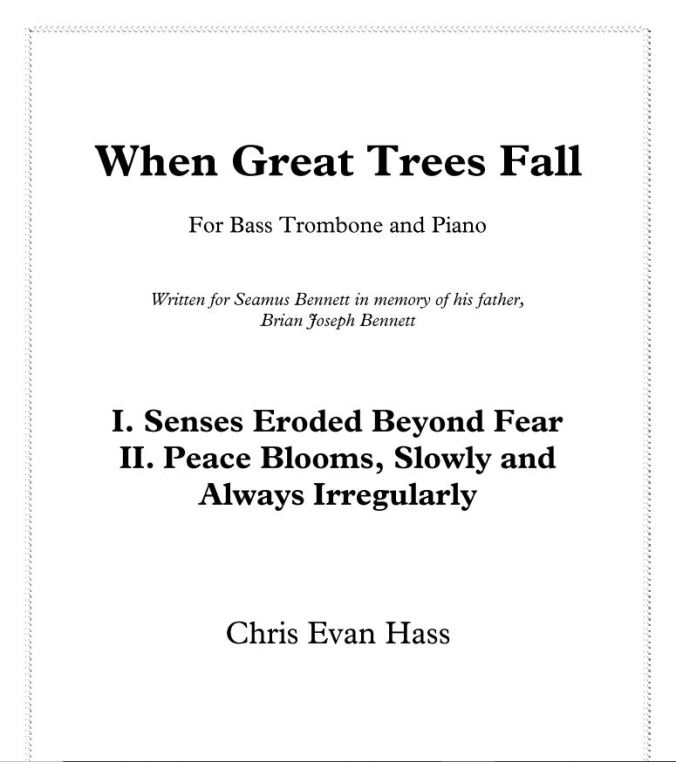
This has been the most challenging and meaningful piece I’ve ever written. When Seamus Bennett first contacted me to talk about writing a piece in dedication to his father, Brian Joseph Bennett, who had just passed away, I was both humbled and completely intimidated by the request. So much of my music has been inspired by volcanoes, unusual weather patterns, or other trivial nonsense, so writing a piece to help Seamus and his family through this tragedy was an important, if daunting, responsibility.
Writing this piece about losing a father proved to be a deeply personal and emotional journey for me as well, as this June will be fifteen years since my own father passed away. Revisiting the thoughts and emotions I experienced during that time was poignant and uncomfortable, but expressing them through music in this way felt cathartic.
The title of the piece, “When Great Trees Fall”, comes from a poem by Maya Angelou that explores how we process and cope with the loss of a loved one. The piece is divided into two movements that each uses a line from the poem as its subtitle. The first movement, “Senses Eroded Beyond Fear”, depicts the immediate and visceral emotions after losing a loved one, alternating between somber numbness and illogical rage. The second movement, “Peace Blooms, Slowly and Always Irregularly”, represents the hopeful and optimistic sentiment that, even though there may still be lingering pain and sadness, time will bring healing and peace.
I am immensely grateful to Seamus and the Bennett family for trusting me to write a piece of this importance and sincerely hope that it will help them through the grieving process in some way.
I’m beyond excited to share the premiere performance of my choir piece Hiraeth, performed this past February by the Central Michigan University Chamber Singers!
Hiraeth is near and dear to my heart as it was simultaneously the last piece I worked on in undergrad and the first piece I worked on during my master’s (I actually showed Frank Ticheli a very early sketch of the piece in a masterclass at WMU four years ago today, back when I was writing this for solo piano!). I channeled a lot of the emotions I felt during this transitional time in my life into this piece in order to portray the sense of yearning and sentimentality that the piece is about.
It was such a cathartic experience hearing the CMU Chamber Singers bring this piece to life with their moving and heartfelt performance after all of these years!
Program Notes:
Hiraeth (pronounced HEER-eyeth) is a Welsh term, loosely translated to a longing and nostalgia for home. More than mere homesickness, it is an expression of a bond for a home to which you cannot return; a home that never was. This piece portrays this feeling of eternal longing through unresolved dissonances and a melody riddled with anticipations and suspensions, feeling as though it is constantly chasing and unfulfilling the harmony. The text used for this piece was written by Tim Davis in 2007 and is as follows:
Hiraeth beckons with wordless call,
Hear, my soul, with heart enthrall’d.
Hiraeth whispers while earth I roam;
Here I wait the call “come home.”
Like seagull cry, like sea borne wind,
That speak with words beyond my ken,
A heartfelt cry with words unsaid,
Calls a wanderer home instead.
I heed your call, Hiraeth, I come
On westward path to hearth and home.
My path leads on to western shore,
My heart tells me there is yet more.
Within my ears the sea air sighs;
The sunset glow, it fills my eyes.
I stand at edge of sea and earth,
My bare feet washed in gentle surf.
Hiraeth’s longing to call me on,
Here, on shore, in setting sun.
Hiraeth calls past sunset fire,
“Look beyond, come far higher!”

 Chris Evan Hass, Composer